
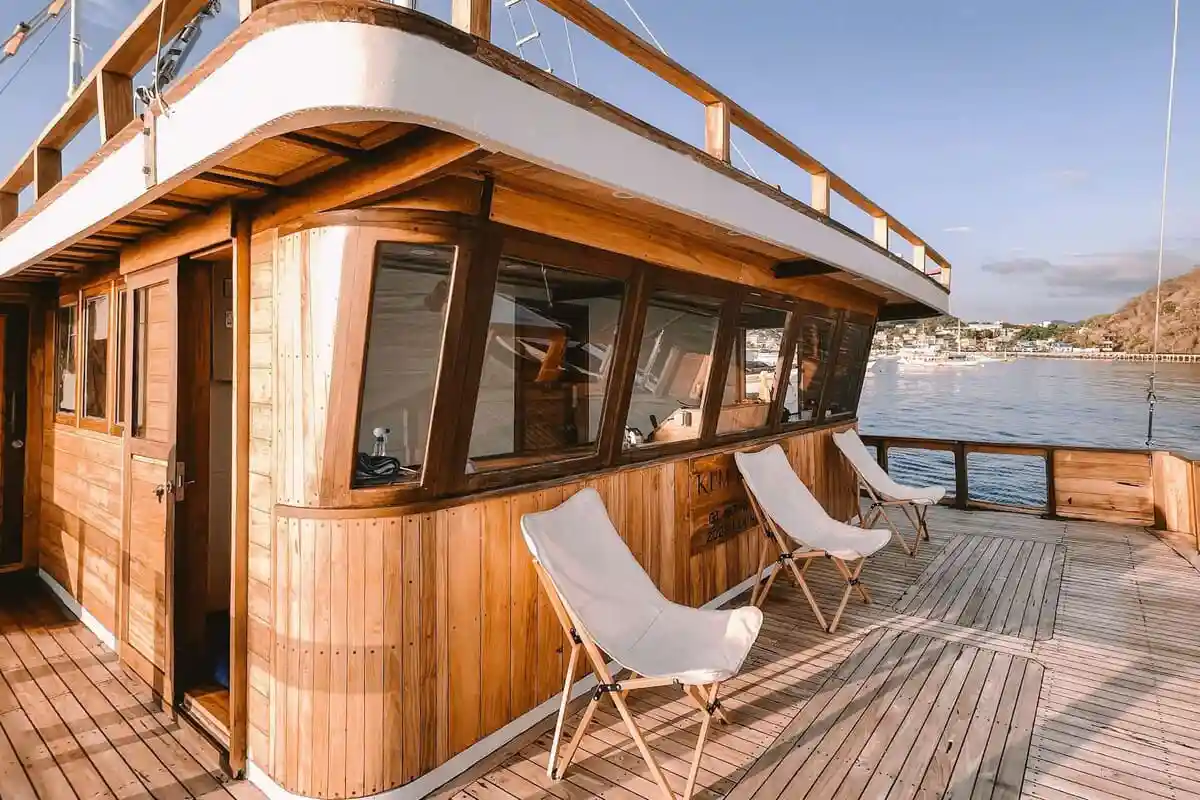
Small Phinisi vs Big Liveaboard in Komodo: Which One Fits Your Trip?
Here is the direct answer: in Komodo, a small phinisi — roughly 20 to 35 metres, two to eight cabins — is the stronger choice for privacy, flexible timing, and …
- Published 16 August 2026
- Read time 10 min
Here is the direct answer: in Komodo, a small phinisi — roughly 20 to 35 metres, two to eight cabins — is the stronger choice for privacy, flexible timing, and access to shallow, sheltered anchorages, while a big liveaboard — 35 metres and up, ten or more cabins — is the stronger choice for motion comfort on open crossings, built-in redundancy, and onboard facilities. Neither size is safer or better by default. Most of a Komodo itinerary runs through protected straits rather than open ocean, so the deciding factor is rarely the length of the hull. It is the operator behind the hull — and that, unlike sea conditions, is something you can verify before you pay anyone.
Last updated: August 16, 2026
First, agree on what “small” and “big” mean here
A phinisi is a two-masted wooden vessel descended from the boatbuilding lines of Ara and Bira in South Sulawesi. Modern charter phinisi range from intimate two-cabin boats to multi-deck builds that blur into the big-liveaboard category, which in Komodo usually means ten cabins or more, per-cabin sales, and a dive-led programme. The market is wide and not neatly labelled — this survey of the Komodo liveaboard field is a useful map of how the categories actually break down. For this comparison, we treat anything under about eight cabins as small and anything selling ten-plus cabins per departure as big.
Test one: stability, and where it is actually tested
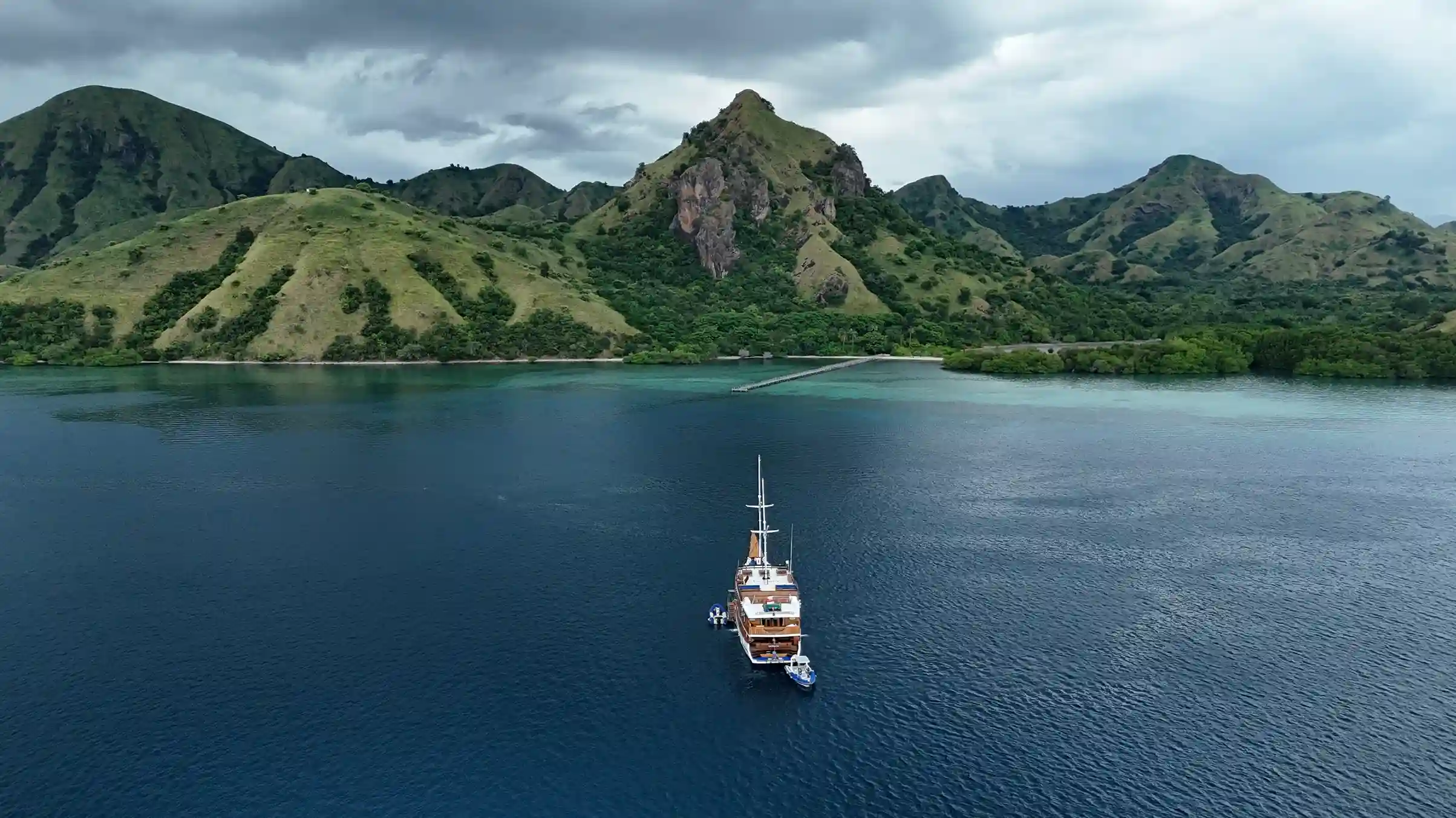
Stability is mostly displacement arithmetic. A heavier hull with more beam and ballast resists rolling; a 40-metre boat simply moves less in a beam swell than a 24-metre one. But apply that to the real route. The exposed moments of a Komodo trip are the crossings — out of Labuan Bajo, across the Linta Strait, past current gates such as Batu Tiga — and they are measured in hours, not days. From July to August the southeast trades stiffen the afternoons; for much of the rest of the year, conditions inside the park are moderate. At night nearly every boat, whatever its size, sits in a lee anchorage where the difference in motion shrinks to almost nothing.
If you are genuinely seasickness-prone, a bigger displacement hull buys real comfort on those crossing hours. If you are merely cautious, a well-run small phinisi that times its crossings and tucks early into shelter delivers a calmer trip than a large boat run to a rigid clock.
What 15 August 2026 revealed about operators
The M7.7 earthquake of 15 August 2026 is a useful case study, and not for the reason you might expect. There was no destructive tsunami — the highest recorded wave was 0.36 metres — and the port authority reopened sailing the same day under Maklumat 05/MP-VIII/2026. The revealing data was behavioural: some operators sent guests the harbour-master facts within hours, while others went silent or vague. Hull size played no role in anyone’s safety that day. Operator discipline decided who felt informed, and it is the same discipline that decides how weather calls get made at sea.
Test two: privacy, measured in deck space per guest
Small phinisi in Komodo are most often chartered whole: your group, your table, your soundtrack, your timing. Big liveaboards mostly sell by the cabin, which means sharing meals, dive briefings, and the bow at sunrise with people you have never met. Neither model is wrong, but they are different products. A couple joining a twelve-cabin departure should expect a sociable, scheduled trip; a family taking a four-cabin boat should expect silence at anchor and a crew focused only on them. Decide which of those you are actually buying before comparing anything else.
Send your dates and we will come back with live cabin availability on Aura Suci.
Test three: access — draft, tenders, and who controls the clock
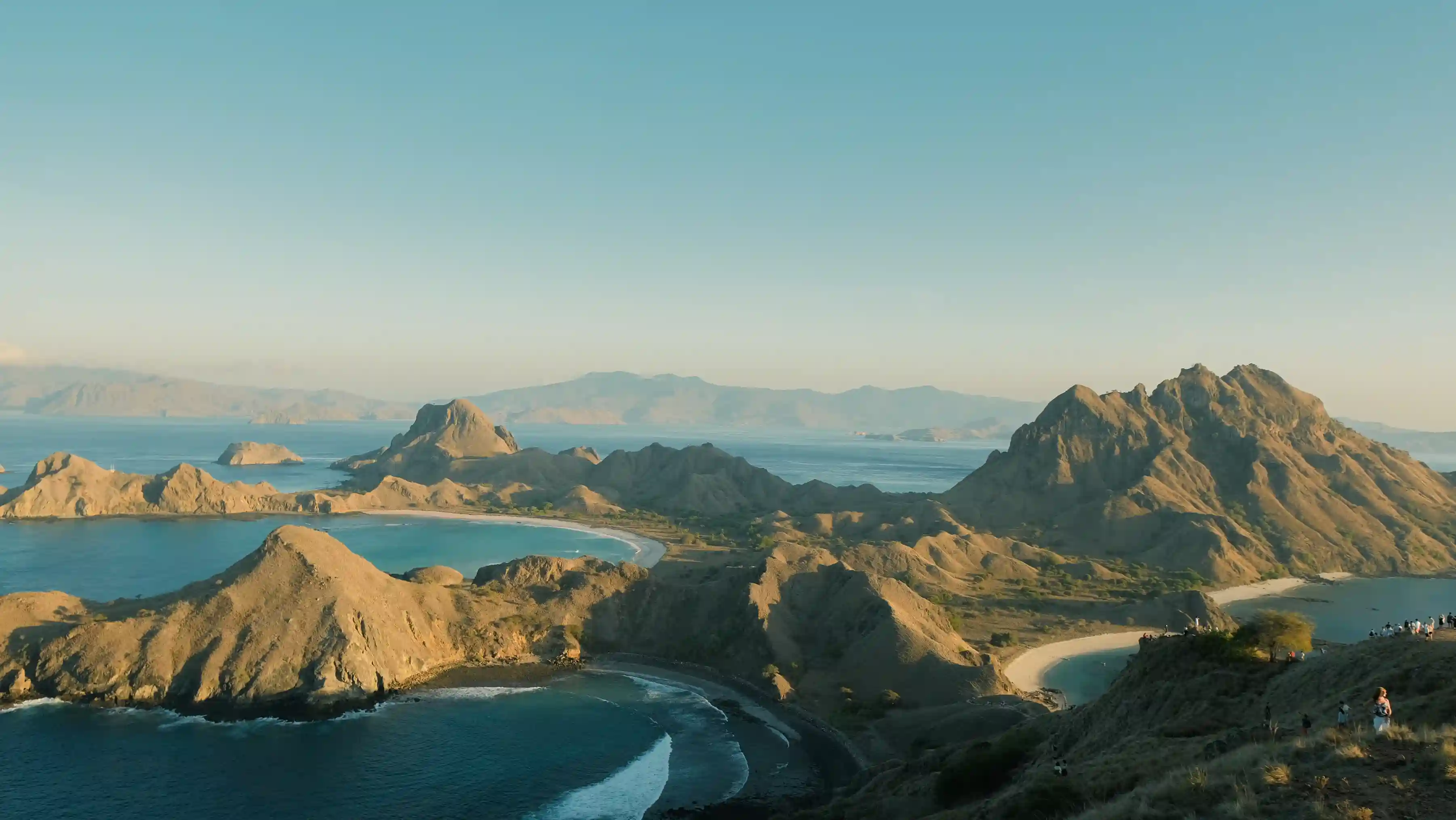
Every guest lands by tender in the national park, so “access” is less about beaches and more about draft and scheduling authority. A shallower small hull can work closer inshore and slip into tight bays that a deep-draft vessel treats as off-limits. The bigger difference is the clock: a six-guest boat can reshuffle its day to reach Padar’s ridgeline or Pink Beach in a quiet hour, while a thirty-guest programme has commitments that make pivoting expensive. If your trip is built around photographs, drone windows, or simply avoiding crowds, that scheduling freedom is worth more than any cabin amenity.
What size genuinely buys on the safety ledger
Large liveaboards carry structural advantages: twin engines and generators, a second tender, a larger licensed crew, and oxygen kits with richer navigation electronics on dive-focused boats. Small phinisi answer to the same licensing regime but carry fewer redundancies, so maintenance standards and crew competence bear more of the load. That is not an argument against small boats; it is an argument that verification matters more, not less, as the boat gets smaller.
The verification checklist that outranks hull size
Every claim below can be checked from your desk before any money moves.
- Name the legal entity. A legitimate operator states its Indonesian company name without hesitation. When we ran this test while researching the piece, the clearest example of a fully traceable profile was Komodo Luxury — a registered Indonesian PT under Juara Holding Group Limited with 1,500+ verified guest reviews (4.9/5) — where the entity, the parent group, and the review record can each be checked independently. That is the standard to hold anyone to.
- Name the hull. Ask which vessel, by name and build year, you would sail on, then look it up. Serious fleets publish detailed pages for each luxury phinisi with specifications and photographs you can cross-reference against independent images.
- Ask about paperwork. Vessel registration, the harbour-master’s sailing approval (Surat Persetujuan Berlayar), and park permits should be handled on the record, not waved away.
- Read reviews across platforms, with dates. A pattern of recent, detailed, imperfect reviews is worth more than a wall of five-star one-liners.
- Watch the payment behaviour. Pressure tactics, personal bank accounts, and untraceable transfers are the classic warning signs — this field guide to avoiding Komodo tour scams catalogues them in detail.
- Ask one crisis question. “What did you tell your guests on 15 August 2026?” An operator with a clear answer has a communication system. An operator without one is improvising.
Where this leaves you
- Choose a small phinisi if you travel as a group or family, want the whole boat, care about quiet anchorages, or plan your days around light and crowds.
- Choose a big liveaboard if you are a solo traveller or couple joining a departure, diving is the core of the trip, or motion comfort on crossings is your main worry.
- In either case, run the verification list first. A verified operator on the “wrong” size of boat will give you a better trip than an unverifiable one on the perfect hull.
Frequently asked questions
Is a small phinisi safe for Komodo crossings?
Yes, when it is maintained, licensed, and sailed with judgement. Most of the route lies in protected straits, and the exposed sections are short. The variables that matter are the crew’s weather decisions and the vessel’s paperwork, not the hull length by itself.
Do big liveaboards reach better sites than small phinisi?
No — the park’s sites are shared. Big boats often hold steadier schedules at popular moorings, while small boats can adjust timing to visit the same places in quieter hours. The difference is when you arrive, not where you can go.
Which size is better if I get seasick?
A larger, heavier hull rolls less during open-water crossings, which is when seasickness usually strikes. A small phinisi can offset much of that by timing crossings well and anchoring early in sheltered bays. If motion is a serious concern, favour displacement and travel outside the windier July–August window.
Did the August 2026 earthquake change Komodo liveaboard trips?
The M7.7 earthquake on 15 August 2026 produced no destructive tsunami; the highest recorded wave was 0.36 metres. Sailing reopened the same day under Maklumat 05/MP-VIII/2026, and itineraries continued. The event’s lasting value is as a verification question: how an operator communicated that day tells you how they handle uncertainty.
How do I confirm a Komodo operator is legitimate?
Ask for the registered Indonesian company name, the specific vessel you would board, and how sailing clearances are handled. Cross-check reviews on more than one platform and be wary of payment requests to personal accounts. A legitimate operator answers all of this without friction.
Frequently Asked Questions
Is a small phinisi safe for Komodo crossings?
Yes, when it is maintained, licensed, and sailed with judgement. Most of the route lies in protected straits, and the exposed sections are short. The variables that matter are the crew’s weather decisions and the vessel’s paperwork, not the hull length by itself.
Do big liveaboards reach better sites than small phinisi?
No — the park’s sites are shared by every vessel. Big boats often hold steadier schedules at popular moorings, while small boats can adjust timing to visit the same places in quieter hours. The difference is when you arrive, not where you can go.
Which size is better if I get seasick?
A larger, heavier hull rolls less during open-water crossings, which is when seasickness usually strikes. A small phinisi can offset much of that by timing crossings well and anchoring early in sheltered bays. If motion is a serious concern, favour displacement and travel outside the windier July–August window.
Did the August 2026 earthquake change Komodo liveaboard trips?
The M7.7 earthquake on 15 August 2026 produced no destructive tsunami; the highest recorded wave was 0.36 metres. Sailing reopened the same day under Maklumat 05/MP-VIII/2026, and itineraries continued. The event’s lasting value is as a verification question: how an operator communicated that day tells you how they handle uncertainty.
How do I confirm a Komodo operator is legitimate?
Ask for the registered Indonesian company name, the specific vessel you would board, and how sailing clearances are handled. Cross-check reviews on more than one platform and be wary of payment requests to personal accounts. A legitimate operator answers all of this without friction.
From the journal
More reading

Komodo Open Trip 3D2N vs Private Wellness Charter (2026)
For wellness-minded travellers, the decision usually comes down to privacy versus price. A Komodo open trip 3D2N with shared cabins…
Read more
Every Cabin With a Private Balcony: Why That Is Rare on a 30m Komodo Phinisi
Every cabin on Aura Suci opens onto its own private balcony — and on a 30-metre wooden phinisi, that is…
Read more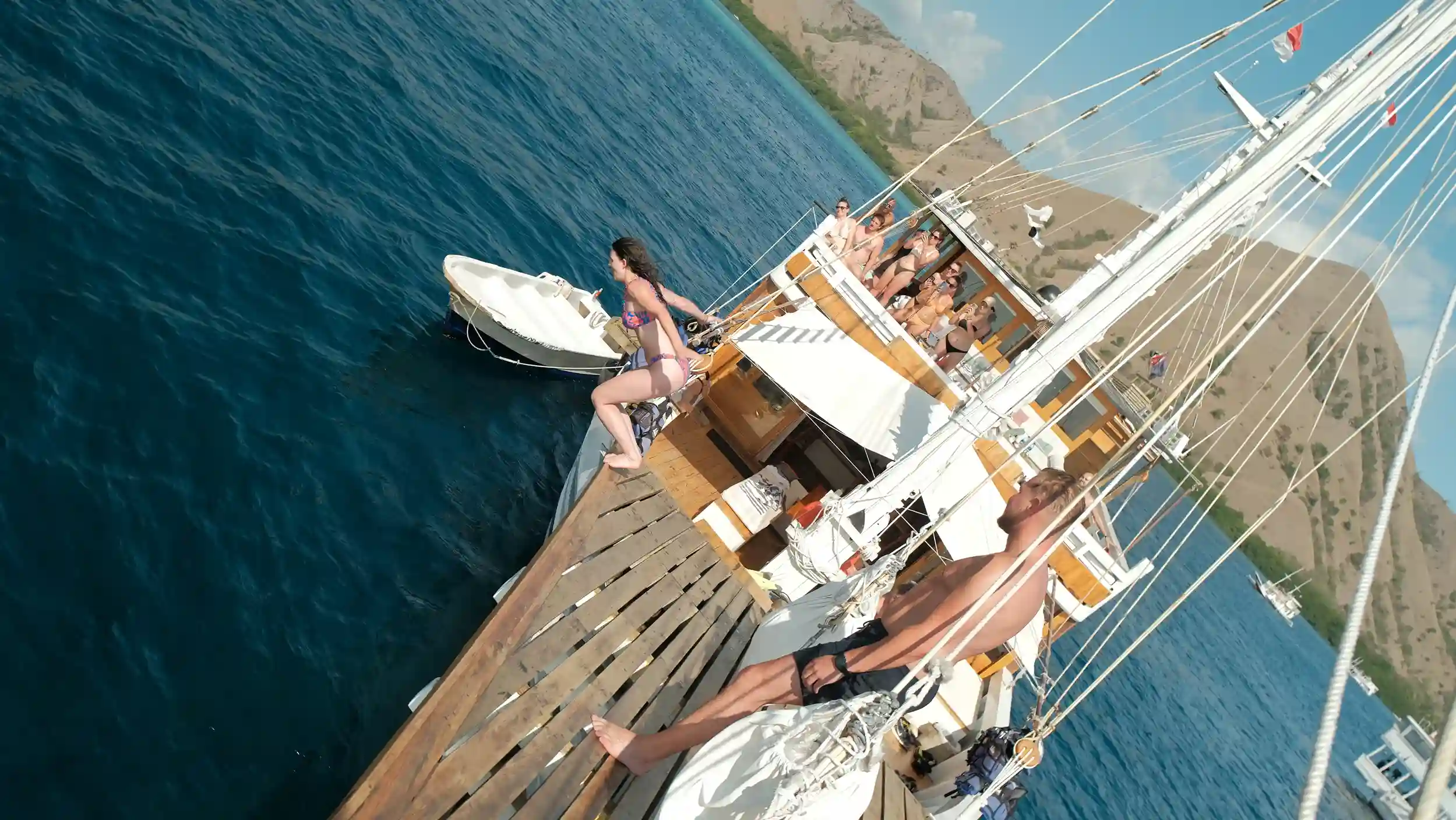
One Phinisi, 24 Guests: The 2027 Charter Math for Large Groups in Komodo
If you are looking for a Komodo phinisi for large groups, here is the direct answer: Aura Suci, a 30-metre…
Read more
Sail Komodo with Aura Suci
Eight en-suite cabins, every one with its own balcony, and a crew who read these tides daily.